Guided interviews
Plain-language prompts surface missing lineage, bias mitigation, and oversight duties before legal review.
Compliance console
Annex IV composer
Work through ten Annex IV blocks with guided prompts, evidence checks, and editable drafts.
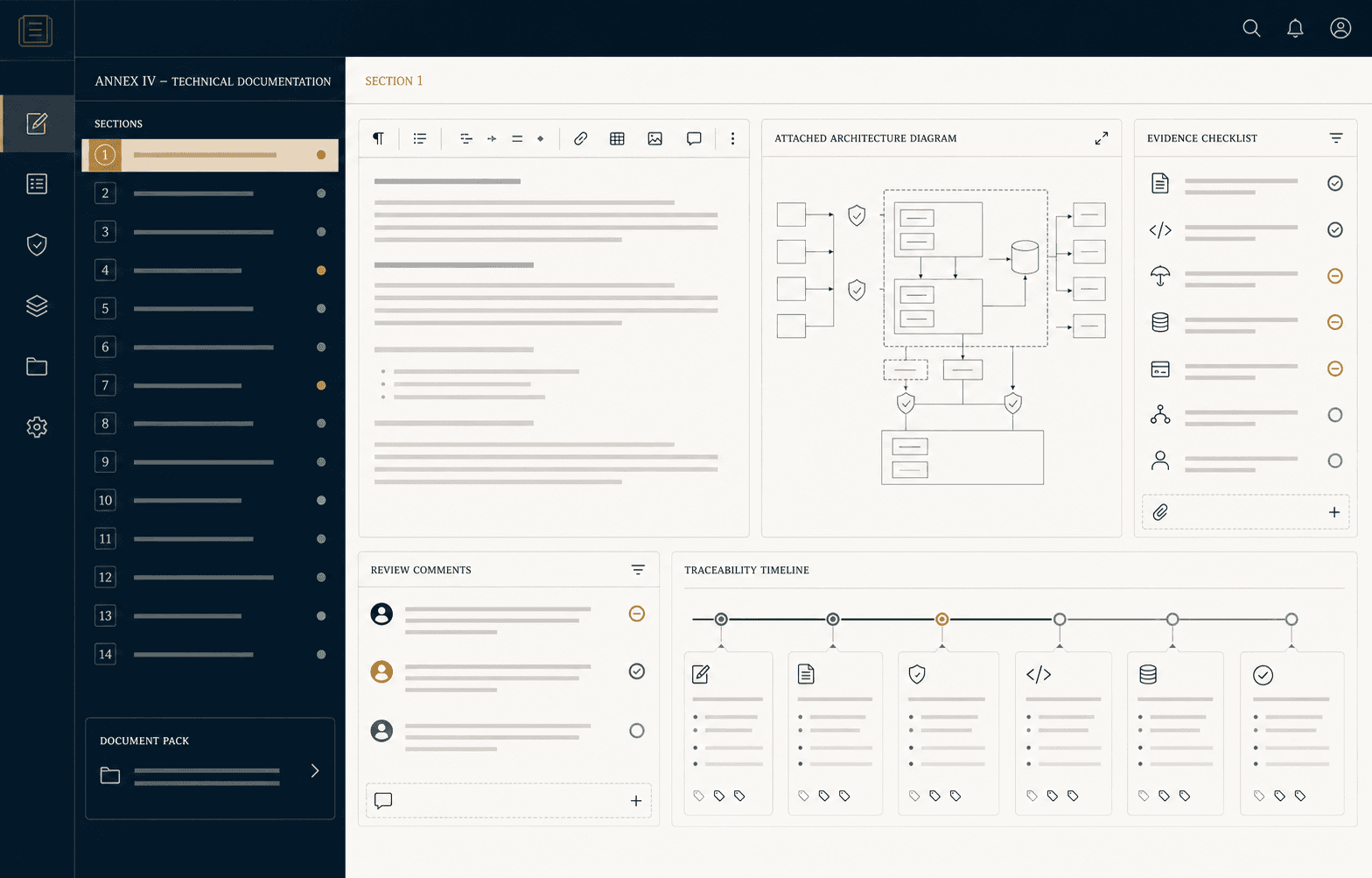
Reduce copy-paste between Confluence, Git, and policy PDFs — one narrative with traceable references.
Plain-language prompts surface missing lineage, bias mitigation, and oversight duties before legal review.
Attach architecture files, logs, and tickets so each paragraph maps to an artifact auditors can open.
Progressive completion meter shows which Annex chapters still need evidence — not just text.
Cross-walk risk management measures to the technical capabilities you actually deploy in production.
Re-open any section after a model or data change; diffs highlight what must be re-attested.
Export polished summaries for boards while engineers keep the deep annex in version control.
Annex workflow
Wizard view · align with internal style guides before external filing
Ten sections under Annex IV — complete evidence before sign-off.
Document training, validation, and testing data — origin, selection criteria, and bias mitigation — with enough depth for competent authorities to verify claims.
Analyzing technical sources…
“I've identified pipelines referring to 'Synthetic-Set-Alpha'. Is this the primary training corpus for bias mitigation?”
Documentation must allow authorities to assess compliance — include bias metrics, limitations, and mitigation strategies in one coherent narrative.